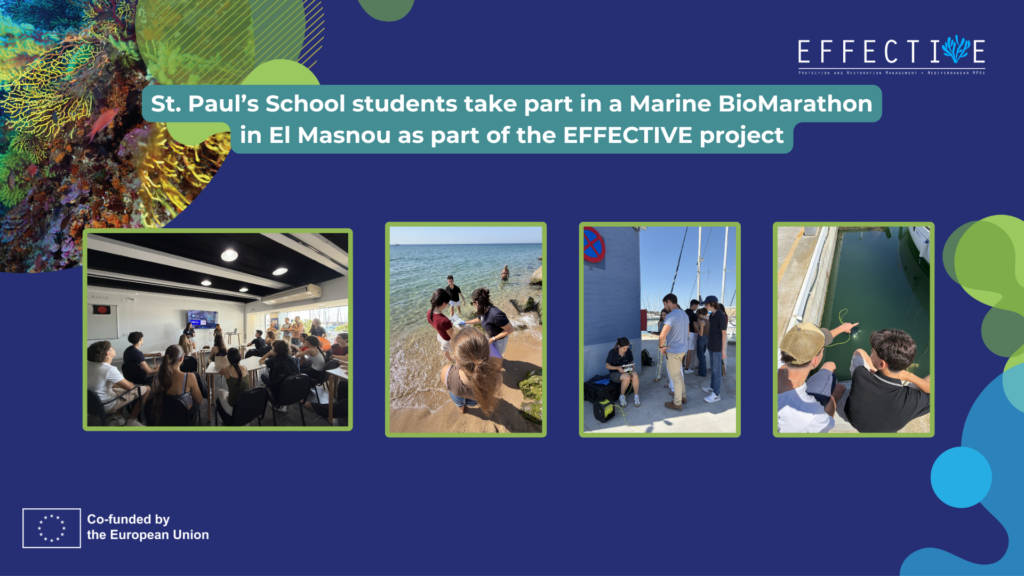

On 17 June, 25 secondary school students from St. Paul’s School took part in a Marine BioMarathon at Platja d’Ocata in El Masnou (Catalonia, Spain). The citizen science activity was organised within the framework of the EFFECTIVE project to bring young people closer to marine biodiversity and coastal observation.
The activity was linked to the COSEA App, an application promoted by the EFFECTIVE project and developed using SPOTTERON Citizen Science technology. This tool allows users to record observations of the marine and coastal environment and share them with the community, making it easier for different audiences to take part in the collection of environmental data.
During the day, the students were divided into groups and, with the support of field guides, explored the beach to identify and register any species, marine litter or habitats they found. In total, 42 new observations were recorded through the app: 16 on coastal species (including birds, fishes, shells, and algae), 23 on pollution and human impacts, 1 on water quality and 2 on habitat.
The day included three rotating activities led by the technical team coordinating the event. Ocean Ecostructures was represented by Núria Trilla, Sol Anglada and Edna Pacareu. Lucía Millán, from the Institute of Marine Sciences, ICM-CSIC, also took part in the activity.
At Espai Blau in Masnou Port, students received a talk and short presentation on the coralligenous habitats in the Mediterranean, benthic habitats and the importance of communities such as gorgonians, as well as the threats these ecosystems face, particularly marine heatwaves and mass mortality events. The session, led by Lucía Millán, also highlighted the importance of monitoring to obtain real, measurable follow-up data on the state of marine ecosystems and renaturalisation actions.
During the second part of the presentation, Núria Trilla, provided context on the EFFECTIVE Pilot 1 technology, Ocean Ecostructures’ Life Boosting Units (LBUs). This technology, based on scalable marine regeneration solutions is designed to increase habitat diversity, promote the settlement of benthic organisms and create refuge areas for the development of marine life, including juvenile fish.
In a second part of the session, the students visited the dock to see the installed marine structures and learn first-hand about the monitoring work carried out with an ROV, guided by Sol Anglada, an expert in underwater ROV piloting. This allowed the students to connect the observations made on the beach with the regeneration and monitoring solutions promoted by the project.
The BioMarathon was an opportunity to show how citizen science, digital tools and environmental education can contribute to generating knowledge about the marine environment.
Through the COSEA App, the students became marine explorers for a day and actively contributed to the observation and protection of the coastline.