
Shaping Sustainable Mediterranean MPAs:
Insights from the EFFECTIVE Bow-Tie Workshop in L’Estartit
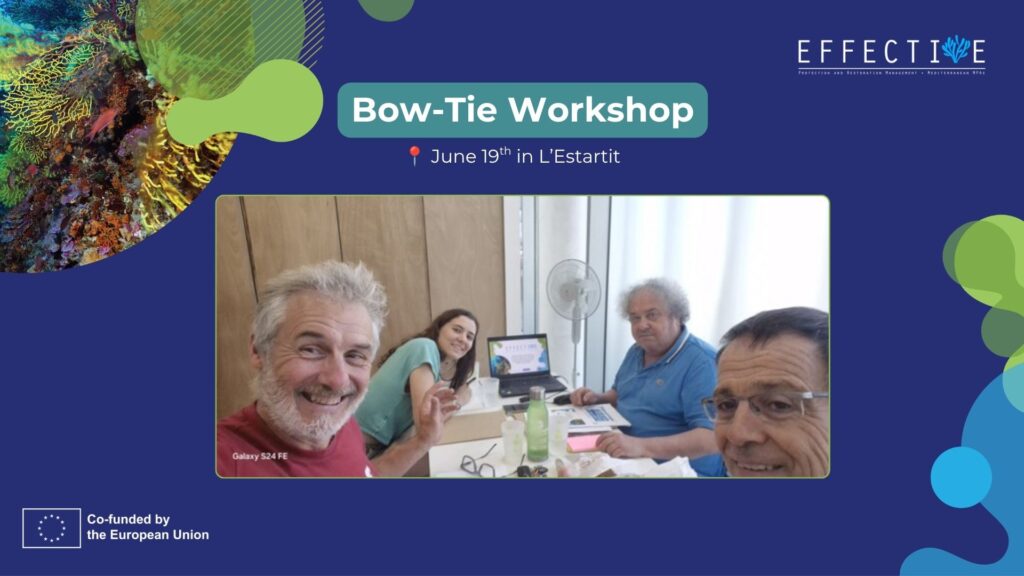
On June 19th, a specialized workshop was held in L’Estartit to advance ecosystem-based management solutions for Mediterranean Marine Protected Areas (MPAs). Organized under the framework of the EFFECTIVE project, the session brought together a dedicated group of experts to conduct a rigorous Bow-Tie risk assessment focused on balancing recreational coastal activities with marine conservation.
What is the Bow-Tie Approach?
The Bow-Tie analysis is a structured methodology originally adapted from the oil and gas industry to map out risk sources, causes, consequences, and—crucially—preventive and mitigative management measures. As an established ISO risk assessment technique, it provides a clear framework for marine planners to evaluate how specific activities impact the Good Environmental Status (GEnS) of protected waters.
For this specific session, the workshop focused on a highly pressing environmental challenge along the Costa Brava: the anchoring of recreational boats in MPA coves. The primary goal was to assess and mitigate the risk of anchor damage to fragile Posidonia oceanica seagrass meadows.
Inside the Workshop: A Three-Part Strategy
The workshop structured its operational roadmap into three clear phases:
Aligning with the Ecosystem-Based Management System (EBMS)
- Clause A2.1 (Key Aspects Identification): The team previously utilized scientific matrixes to identify marine activities threatening GEnS. While professional fisheries theoretically cause significant pressure, the team strategically selected boat anchoring for this case study due to the vast amount of existing regional data and a high capacity for immediate management intervention.
- Clause A2.2 & A2.3 (Goals & Management Programs): Using a free, user-friendly bow-tie software, the group mapped out human and natural risk causes to formulate an advanced “vulnerability profile” for coves across the Cap de Creus area.
Utilizing Local Marina Data
The session leveraged extensive real-time tracking data and descriptive sheets compiled from recent contract work completed for the Catalan Marina Association (ACPET). This data allowed the team to classify anchoring coves into three distinct typologies based on actual recreational boating behavior along the Costa Brava.
The Brainstorming Session: Building Barriers
The core of the workshop was a collaborative brainstorming session centered around the central “undesired event”: anchoring on Posidonia meadows and the associated conflicts of recreational boating.
- Addressing Causes: The group systematically evaluated what triggers these events and mapped out preventive “barriers” (such as commercial buoy applications, drawing on the on-site expertise of buoy specialist Boris) to minimize risks before they occur.
- Mitigating Consequences: Using GEnS descriptors, the team began identifying mitigation measures to minimize environmental degradation once anchoring occurs.
- Developing Measures: These identified barriers will be translated into a formal program of management measures, utilizing established frameworks (e.g., Cormier et al., 2018) to build the cycle’s final management program.
Next Steps for the EFFECTIVE Team
While the team successfully mapped out the preventive controls for the causes of anchoring pressures, time ran short before the final consequences could be fully refined. The next steps will involve polishing the remaining consequence pathways to complete the standardized bow-tie framework.
Given the strong interest previously expressed by regional stakeholders like ACPET, the project plans to replicate and scale this workshop model in the near future, expanding the collaborative group to further solidify co-management strategies for Mediterranean blue capital.
